Working with couples, start to finish
For couples therapists: one shared record, each partner's own portal sign-in, an agreement both sign, private intakes, joint and individual sessions, and fair billing.
Updated 19 November 2026
Couples work has a shape of its own. Two people, one shared story, and a therapist who needs to be fair to both. That fairness reaches the admin too: who hears about appointments, who signs the agreement, who reads the messages, who pays. This page follows one fictional therapist and one couple from the first enquiry to the end of their work, and shows how to set Therasee up so both partners feel equally held.
The workflow in one breath: create one couple record with both partners on it, choose who hears about what and who pays, and open your client portal to each partner with their own sign-in. Send the agreement as one form they both sign and the intake as a private copy each, book joint sessions as a series, and keep everything about the couple on the couple's record.

Is this you?
This page is for you if you see couples together: relationship counselling, couples therapy, or any work where two partners come as a pair. If you also see individual clients, the rest of your practice can follow A weekly practice, start to finish.
Meet Eleanor, and Rebecca and Daniel
Eleanor Whitfield runs Brackenfold Therapy, and alongside her individual clients she sees a handful of couples. Her couples sessions are 80 minutes at £90, usually fortnightly. Rebecca and Daniel Ashworth have been together for twelve years and want help communicating after a hard year. Rebecca makes the first contact.
The screenshots on this page come from our demo practice, which has a real fictional couple, so you will see Rebecca and Daniel in them.
1. A couples service, offered to couples you've spoken to
Eleanor has a Couples therapy (80 minutes) service at £90, so every couples booking and invoice gets the right length and fee. Under Settings, My settings, Booking, in the What clients can book card, she sets its New clients to Not offered and its Existing clients to Selected clients. Then, on each couple's record, she ticks the service in the Services box (select Change to see the list), so only her couples can book it from the client portal. A couple always speaks to her before they start, and she sets up their shared record herself. See Setting up your services and prices.
2. One record for two people
After a short call with Rebecca, Eleanor creates the couple's record:
- On Clients, she selects + and, under Client type, chooses Couple.
- She fills in Partner one and Partner two with each person's name, email and phone number. The Record name fills in as "Rebecca & Daniel Ashworth".
- Under Communications, both partners are ticked for confirmations, reminders, changes, form requests and portal messages. She leaves it that way: in couples work, both partners hearing everything is part of being fair.
- Under Billing, she chooses Rebecca, who has said she will pay. The Invoices & receipts row follows the payer, so invoices go to Rebecca.
- She selects Register. Nothing is sent to either partner yet.
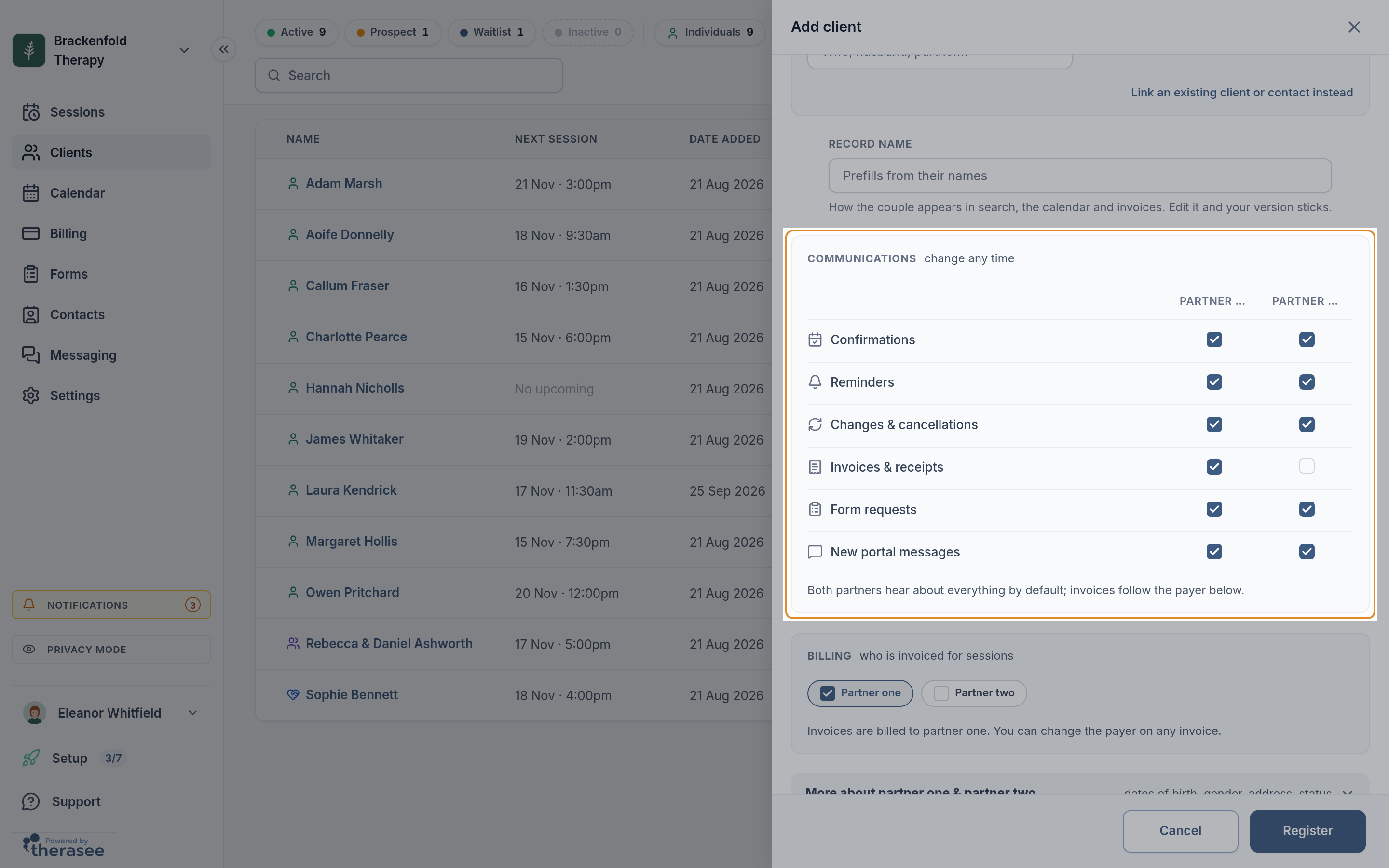
A couple record holds no email address or phone number of its own: everything goes to the partners, using their own details. A partner you type in is saved as a contact rather than as a separate client. If one of them later wants individual therapy with you, they get their own individual record alongside the couple's. See Working with couples.
3. Each partner, their own way in

On the couple's Portal access card, Eleanor turns the switch on, ticks Can sign in for both Rebecca and Daniel, chooses Email and selects Send. Each of them signs in with their own email address and a code, and both see the same shared record: their appointments, messages, forms and invoices. Each of those sections can be switched on or off for each partner on the same card.
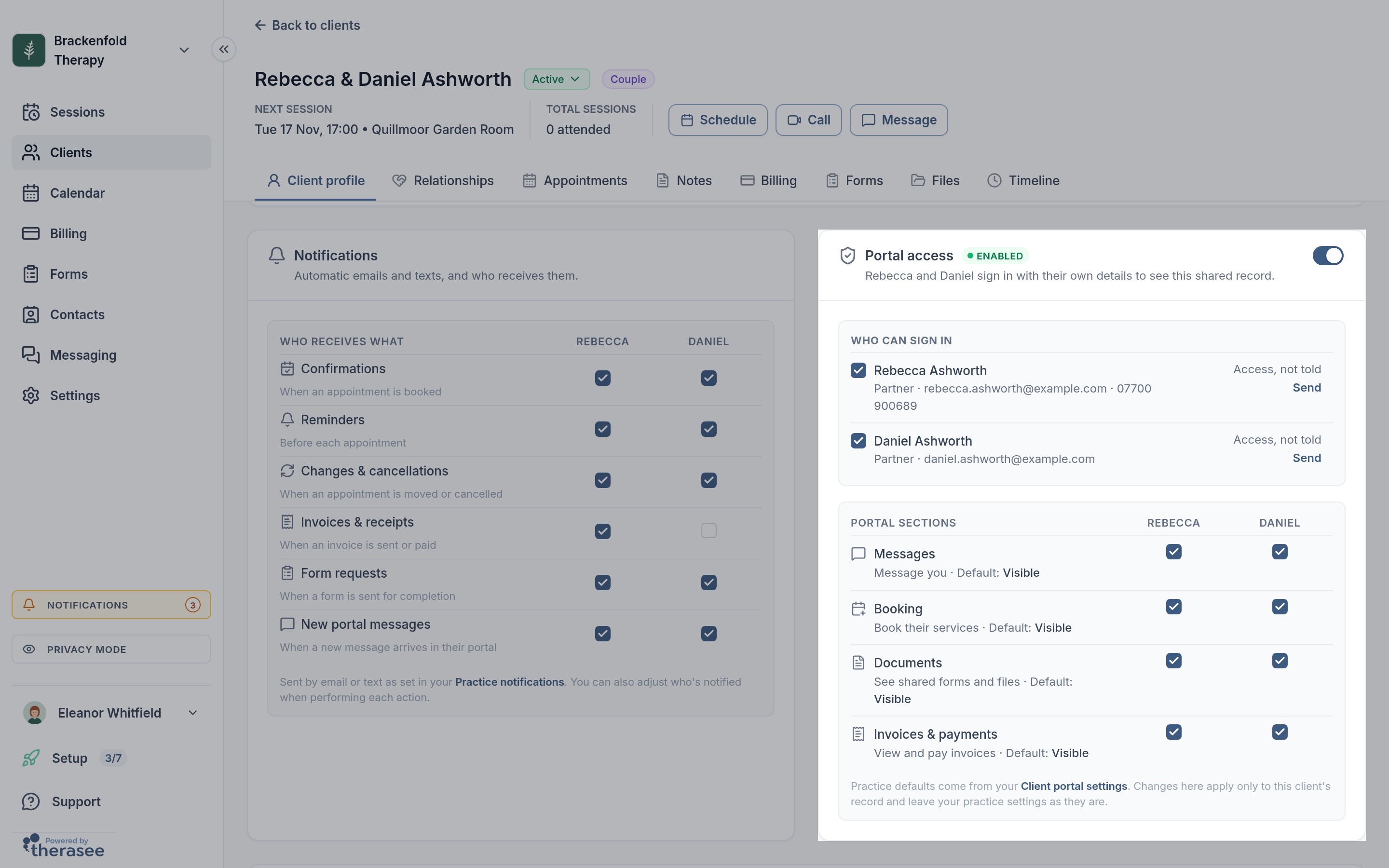
Messages work the same way. A couple has one shared conversation, and everyone who can sign in and see Messages reads everything sent in it, with each message showing which partner wrote it. Eleanor says so in her welcome message, so neither partner writes something they expect to stay private.
4. The agreement, and a private intake each
Eleanor sends two forms before the first session, and the couple record asks her how each should be completed:
- Her couples agreement goes as One form together, and under Who signs this form? both partners are ticked. Each signs their own box, using the link sent to their own email address, and the row shows progress such as 1 of 2 signed.
- Her intake questionnaire goes as A copy each, with answers kept private to whoever filled them in. Each partner can say what has brought them, in their own words, without the other reading it.
Her agreement includes a paragraph on the question every couples therapist has to answer: what happens to something one partner tells her alone. Here is hers, to adapt:
Agreement wording: "I work with you as a couple, so the relationship is my client. From time to time I may speak with one of you on your own, by phone or in a session. I won't keep secrets that affect the work we are doing together. If one of you tells me something the other doesn't know and that matters to our work, I will help you find a way to bring it into our joint sessions. The usual limits of confidentiality, set out above, apply to everything you tell me."
See Creating and sending forms.
5. Sessions together, and occasionally apart
After the first joint session, Eleanor books their sessions as a fortnightly series:
- She chooses the couple as the Client, and Couples therapy (80 minutes). Both partners appear under Attending.
- Under Date & time, she sets Repeats to Every 2 weeks.
- She selects Schedule. In Send confirmation?, both partners are listed as attending, each with their own Email and SMS ticks. She selects Schedule and send.
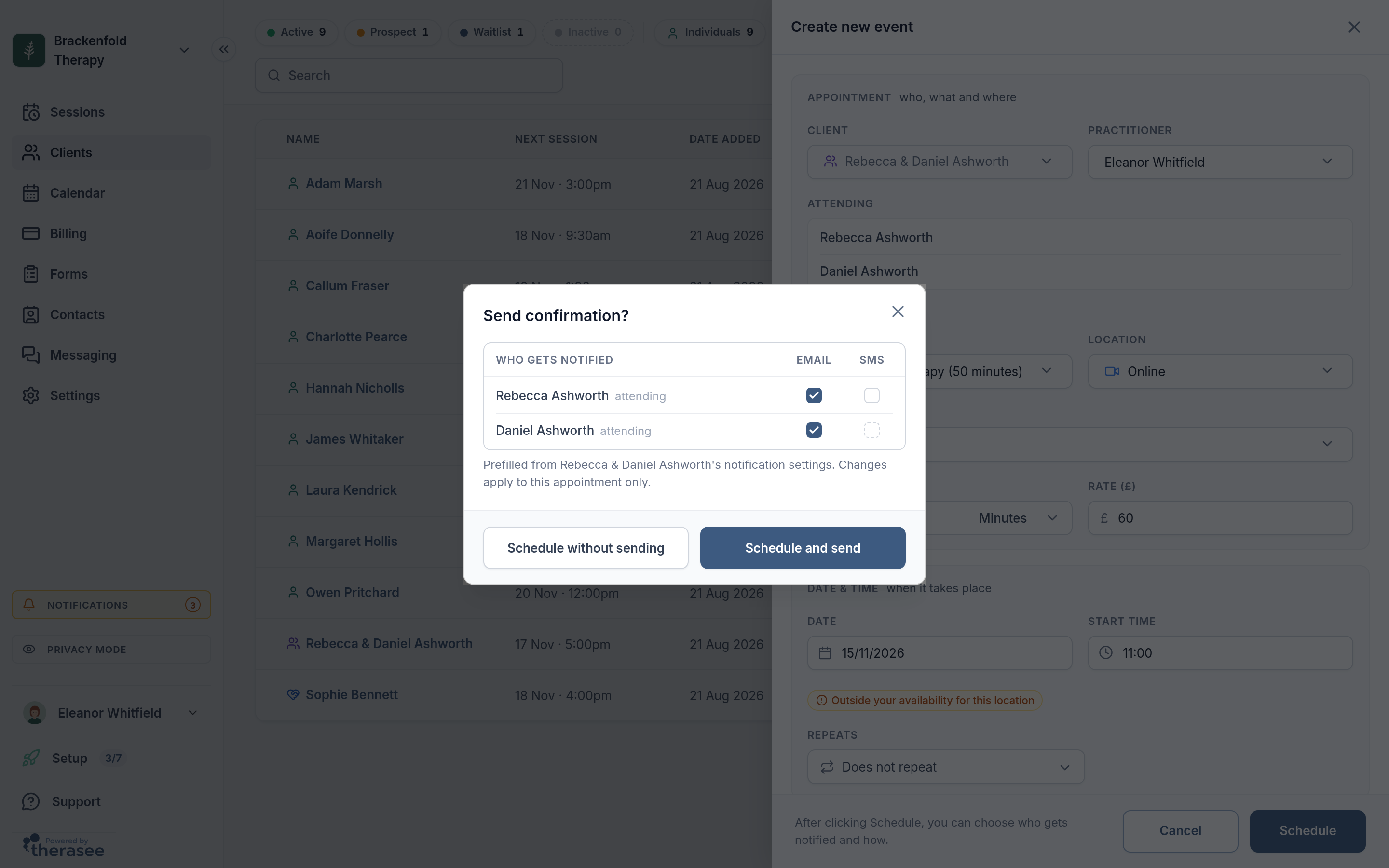
When the couple meet online, each partner who was sent the confirmation by email gets their own join link, so they can join from separate devices or separate places, and each waits in the waiting room under their own name. Eleanor admits them together with Admit all. See Running a video session.
Early on, Eleanor sees each partner once on their own. She books those sessions on the couple's record too, removing the other partner from Attending, because they are part of the couples work. Who attends and who is told are separate choices: the partner who isn't in the room can still be sent the confirmation, which keeps everything in the open.
6. One payer, fairly
Invoices for the couple's sessions are made out to the couple and billed to Rebecca, the paying partner. With automatic invoices on and Email ticked, each one goes to her without Eleanor doing anything. If a couple share the cost by taking turns, Eleanor invoices their sessions herself instead: she books the series with Invoice each session automatically off, and when she creates each invoice from Billing she selects Change payer on the ones the other partner pays. The couple's default payer stays as it is. See Creating and sending an invoice.
7. Notes that belong to the couple
Eleanor writes her notes for joint sessions, and for the individual sessions that are part of the couples work, on the couple's record. If one partner later begins their own individual therapy with her, that work, and its notes, belong on their own individual record. See Writing session notes.
When the work changes

- One partner stops coming. Book sessions with the partner who attends by removing the other from Attending. If the other should no longer hear from you, untick them in the couple's Who receives what table and in Portal access.
- One partner wants individual therapy. Give them their own individual record. When they sign in, they see Who are you here for? and choose their own record or the shared one.
- The couple separate. Untick each partner from what they should no longer see or receive, and decide with each of them what happens next.
- The work ends. Set the couple's status to Inactive on Clients. Everything on the record stays in place.
Make it yours
- Weekly couples. Choose Weekly under Repeats instead.
- One partner pays every time. Leave Billing on that partner and never touch Change payer.
- A partner without email. Add their mobile number on the couple's Client details card, so they are texted wherever your practice sends texts, and tick SMS for them in Send confirmation? when you book.
- A shared intake. Send the intake as One form together if you prefer the couple to complete it side by side.
- No individual sessions. Leave both partners under Attending every time, and say so in your agreement.
Questions couples therapists ask
Can each partner see what the other writes in a form?
Only if you choose. Send a form as A copy each with answers private, and each partner sees only their own answers.
Does each partner get their own reminders?
Yes. Both partners are reminded to begin with, each at their own email address or phone number, by the channels your reminder settings use. Untick a partner in Who receives what if they shouldn't be.
Can one partner message me privately?
Not through the couple's conversation, which both partners can read. If one partner has individual therapy with you, their own record has its own conversation.
Can we split each invoice between the two of them?
Each invoice has one payer. To share the cost, create the couple's invoices yourself and bill the partners in turn with Change payer.
Do both partners count as clients on my plan?
A couple is one client record. Partners you type in when you add the couple are saved as contacts; a partner you link as an existing client stays a client too.
Couples come to therapy hoping to be heard, both of them. Setting up the record so neither partner is left out of the loop is a small part of that, and it's one Therasee can carry for you.
Was this helpful?